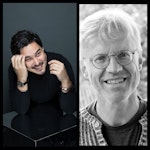
We have gathered three of NMH's master students in piano performance – Mirei Aoto from Japan, Damiën Heemskerk from the Netherlands and Norwegian Herman Bakke Karlsen. They all play master concerts this March.
Keys and Ideas

Spring 2026 is a busy season for the Academy's pianists. And even though they play the same instrument, their approach to performing is unique to each musician.
Fifty Shades of Grieg
Mirei didn't choose Norway at random – she discovered Norwegian music while still back in Japan.
"I'm super interested in Norwegian music!"
Her master's project focuses on pieces related to Norwegian and Japanese folk music. She emphasises that she does not wish to compare the two, rather showcase them side by side.
To Mirei, it's important to respect the folk music aspect of the music. At the same time, her background allows her to adopt a different perspective, she says.
According to Mirei, Japanese piano music is hard to find, and the folk-related pieces are usually for orchestra or traditional instruments. At the March concert, she will perform piano music by Akira Ifukube, the composer known for the music from Godzilla (1954).

On the Norwegian side, Grieg is, of course, important to her, just as it is to her classmate Herman. He has named his project "Norwegian Soundscapes".
"I'm trying to find pieces that are not that much played, cause there is so much Norwegian piano music. After Grieg, you have Sæverud and Tveitt, but there are so many other composers as well," Herman says.
He wants to show a different side of Norwegian piano music, which is not so folk-related or perhaps more European-sounding, as he puts it. He mentions Alf Hurum, Klaus Egge, Fartein Valen and Lasse Thoresen.
"This is also Norwegian music. And it's good music!"
He adds:
"This project is very personal. All the pieces I am playing, I have a personal relationship to."
This project is very personal. All the pieces I am playing, I have a personal relationship to.
pianist

While Mirei began playing the piano at 7, both Damiën and Herman started later – at 12 and 14, respectively. Herman had already worked his way through a bunch of other instruments – drums, the electric bass and the French horn. As a young teenager, he wanted to be an organ player, so he started taking piano lessons to prepare.
But – a great piano teacher led the lightly undecided Herman to finally settle down with his instrument, deciding that piano was his path.
Herman is performing with a singer and a violinist at his concert – adapting and transposing the songs, mostly originally written for the soprano voice of Grieg's wife, Nina, to fit the range of a bass.
Beeps and Dots
As a musician with many ideas, Damiën's master project has morphed into something quite different since the original plan, which was about synesthesia, or the ability to hear colours in music. Thus, the concept included creating a lot of visuals – and that part, he has kept.
"It landed on combining visuals and music in different ways."
He is hand-drawing his own animations for the concert in March, which has the playful name “Mickey-Mousing for Beginners”.
"But I don't know how to draw or animate," he laughs and explains that this is a way to force himself to learn more about a world he is fascinated by.
Mickey-mousing is a technique where the music is composed or synched with the on-screen action of a film or video in mind, so that it exactly matches or exaggerates the on-screen movements. One of the earliest and most famous examples is Disney's "Steamboat Willie."
In Damiën's project, this concept is used in a different way, where music and animation are created simultaneously.
"Visualisation of music is a big art form, but it's hard to expose and made by small-time creators, so it's not something that you see at the cinema. And it's too complicated to put in a museum exhibition."
Repetitive, rhythmic and hypnotic. Those are the qualities that I would love this project to have.
pianist
He shows us a video example by Norman McLaren, which he describes as beeps and dots synchronised.
“The movie and the music cannot be separated, you know?”
His vision for the project is clear, but ambitious.
“Repetitive, rhythmic and hypnotic. Those are the qualities that I would love this project to have.”
Two-Way Influence
Piano is perhaps one of the most common instruments at the Academy, and the classes are larger than in many other study programmes.
“I feel like the environment here is pretty good. I hope you feel the same way,” Herman says, chuckling at his classmates.
Damiën says he has finally found his people – fellow musicians with similar views of music.
“We talk about our projects and collaborate a lot, and then it’s very important to play together.”
Topics such as programming strategies and concert architecture are central to their discussions.
He thinks friendship can make artistic practices and master’s projects grow closer to each other.
An Attack on the Senses
Mirei's favourite is playing piano four hands. She has collaborated closely with a fellow classmate and pianist, performing fours hands repertoire.
"I love chamber music, but especially four hands, since the roles are equal. Then, we can discuss the same instrument and mix the same sounds."
In her experience, it's not enough to just be close friends – you need to almost function as one person. At the same time, respecting each other's opinions and personalities is crucial.
Her concert will be a unique occasion featuring Japanese piano music alongside works by composers such as Agathe Backer Grøndahl, David Monrad Johansen, Geirr Tveitt, and, of course, Grieg.
I love chamber music, but especially four hands, since the roles are equal. Then, we can discuss the same instrument and mix the same sounds.
pianist

An unusual programme is also the case for Herman:
"It's a rare opportunity to hear piano repertoire that's basically never played in Norway – and a special concert where you can get deep into Grieg, not only as an artist, but as a human being."
He refers to a particularly difficult period in the composer's life, and quotes him:
"'First, you have to be human being, all true art emerges from what is human.' My concert reflects that."
Damiën says he is doing his project for himself and jokingly calls it egotistical. Summed up, he gives an intriguing but slightly ominous pitch:
"It will be an attack on the senses. Provoking, energetic, and maybe even a little aggressive."
"I'm sold!" Herman concludes.
Piano concerts this spring
-
 Classical MusicLandscapes of Tradition Tuesday 17 March 19:00
 -
 Classical MusicMickey-Mousing for beginners Friday 27 March 19:00
 -
 Classical MusicThe Voice of the Fantasia Sunday 12 April 18:00
 -
 Classical MusicPiano concert with the class of Christopher Park Friday 24 April 19:00
 -
 Classical MusicHaydn's Piano Sonatas Monday 27 April 19:00
 -
 Classical MusicMann & Bert (If the Schu- fits) Tuesday 12 May 19:00
 -
 Classical MusicDuo Gimse/Park Wednesday 13 May 19:00


