Field of study: Artistic Research
Martin Hirsti-Kvam: Travel i hyperreality
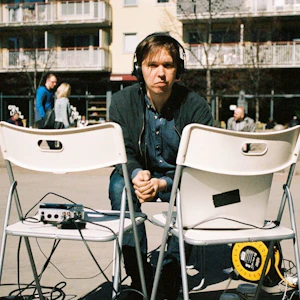
An exploration of the artistic potential in the concept "hyperreality".
Summary
The project is an artistic exploration of the concept of "hyperreality," where Hirsti-Kvam uses headphones and binaural sound to create extended and distorted auditory realities, in which the sound of reality, amplified and intensified, is seamlessly composed with a virtual soundscape, altered to a level where the listener has difficulty distinguishing between the two.
The study is based on the following questions:
- How can one compose with extended and distorted realities in a hyperreal universe using headphones and binaural technology?
- How can the construction of distorted auditory realities influence the way we experience our surroundings?
- How to compose temporally with the medial parameters of a hyperreal universe? What methods, compositional techniques, technical solutions and forms of presentation are suitable for articulating this universe?
- How can the documentation and reflection format mirror and align with the artistic research project? Can an audiovisual reflection format be a sustainable alternative in artistic research?
About the phenomenon "Hyperreality"
Hyperreality is a term drawn from Jean Baudrillard and Umberto Eco, which describes a world where we can no longer distinguish between what is the map (the virtual) and what is the terrain (the real) in a critique of capitalism, especially mass media’s influence on our perception of the world. Hirsti-Kvam has previously worked with the concept of hyperreality in a series of site-specific installation works for audiences with headphones, titled Hyperrealities, in urban public spaces. He wishes to further explore the artistic potential of this hyperreal universe in this project — specifically in the construction of new listening situations, how these should be composed temporally, and how this affects the listening experience and perception of the world around us.
In a post-digital and visual world, it is listening that is the primary sense in this hyperreal universe. Rather than using headphones to shut out the surroundings, I want to use them to open up to the world outside: from private listening to a collective listening experience in "co-presence" with the performers and the other audience members. The hyperreal space is not meant as an escape from reality, isolated from the world, but rather an attempt to achieve closeness to reality — to use technology to help us turn our gaze and ears outward toward the world, an attempt to reclaim listening by framing it and intensifying it, to get closer to reality with all its noise, beauty, flaws, imperfections, and poetry.
Implementation
The compositional method can be roughly divided into three parts: (1) the construction of different hyperreal spaces, (2) the composition over time of the mediation of these spaces through headphones, and (3) the audience’s role (physical placement and potential actions) in these spaces. The plan for the project is to create 11 "hyperreal spaces": site-specific hybrid works that integrate elements from sound installations, sound walks, concerts, and immersive theatre. Each presentation of the artistic works will be followed by a public conversation with the involved performers. In addition, Hirsti-Kvam will organize a final artistic presentation where he curates, revises, and adapts a suitable combination of the selected hyperreal spaces.
***
Martin Hirsti-Kvam is enrolled in the PhD programme in Artistic Research from 1 September 2025.
Published: Jun 12, 2025 — Last updated: Sep 23, 2025